Ned Haig

Born: 7 December 1858, Jedburgh
Played club rugby: Melrose RFC
Played provincial rugby: South of Scotland
Died: 28 March 1939, Melrose

Ned Haig

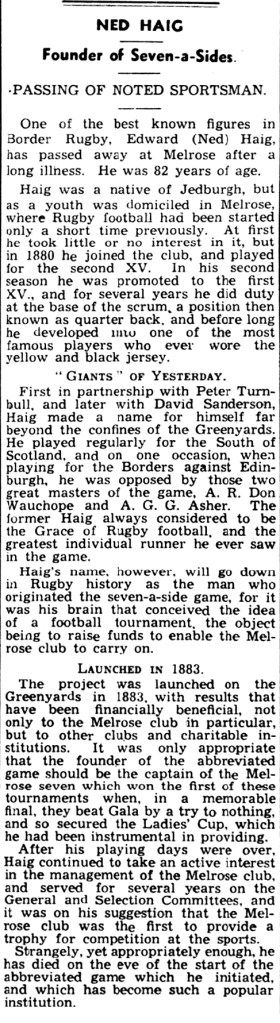
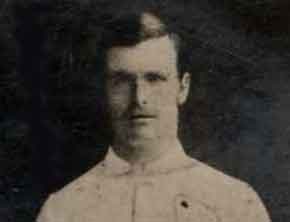
Ned Haig is credited with inventing Sevens rugby. It was Haig, as captain of the Melrose side, and his fellow player David Sanderson [also Haig’s boss outwith rugby] that came up with the idea of a Sevens tournament to raise monies for the club.

The Southern Reporter of 6 April 1939 reported Haig’s death and gives an account of his life:

A memorial to Haig was later built to commemorate him by the Borders rugby clubs. The Berwick Advertiser of 25 July 1940 reporting:

MEMORIAL TO NED HAIG At the annual meeting of the Melrose Club it was reported that the Secretary had for some time past been in communication with the other Border clubs in regard to the suggested erection of memorial stone to the late Ned Haig, (the originator of the sevens game, and as a result a stone will shortly be erected in the Wairds Cemetery, where Haig is buried, the cost of which is being borne all the clubs in the Borders. The stone is in the form of a Celtic Cross, suitably inscribed, and on the base of which is the following inscription: ‘Erected the Border Rugby clubs in memory of the originator of the seven-a-side game.’

https://www.britishnewspaperarchive.co.uk/viewer/BL/0000717/19400725/085/0005

Scotland to India: the spread of Sevens

By tournament:

1886 Khajjiar Gymkhana [29 June]

The list may be subject to change if more rugby union sevens tournaments are discovered.

Khajjiar Gymkhana Sevens match

Scotland’s influence on India increased when the Earl of Dalhousie, James Broun-Ramsay, became the Governor-General of India in the middle of the nineteenth century. The role of the Governor-General of India at the time was to increase British colonial control of India; and increase the power of the East India Company. At the time, the East India Company used a ‘Doctrine of Lapse’ to take over Indian States. This meant that any state either without an heir, or any state that they deemed unworkable the East India Company just took over. The Earl of Dalhousie accelerated the use of the Doctrine of Lapse by militarily playing off Indian States against one another, so that the East India Company could pick up the losing states. This was a dangerous ploy as it increased the military power of Indian States and his colonial detractors conclude that this led to the 1857 Indian Rebellion. His colonial supporters note that Dalhousie brought trains, postage stamps and the telegraph to India.

The Earl of Dalhousie was Governor-General of India between 1848 to 1856. He spent his summers in India in the north in the state of Himachal Pradesh, in the western Himalayas. His retreat, a colonial hill station, formed the basis of a Scottish based town, and called Dalhousie. The area of Dalhousie and Khajjiar is still known as a ‘Little Scotland of India’.

Teams from Chamba and Dalhousie played the first rugby union sevens match in India, in 1886 at Khajjiar. The teams played cricket and association football with Chamba winning both matches. The Chamba side was predominately colonial civilians but also mixed with native Indians. The Chamba side was backed by the Rajah of Chamba; and his brother proved a fearsome bowler in the cricket match.

They met in the Khajjiar Gymkhana; a gymkhana being a sports venue or pitches where predominately colonials, military and civilian, would play, though occasionally native Indians would also play if sides had to make up numbers.

Arguments raged into the night after this, with alcohol flowing. It seemed that the Dalhousie (military) side much preferred rugby union to cricket and association football. They challenged the Chamba (civilian) team to a game of seven-a-side rugby union. The Chamba side having already won at cricket and association football against the Dalhousie side readily accepted.

It was now 1am in the morning when the teams played their Sevens match.

The report from the Civil & Military Gazette (Lahore) of 2 July 1886 is from the era; disappointingly implying that the native Indian Chamba players were to blame for their side’s defeat, playing down that rugby union was the favoured sport of the Dalhousie side.

As many of the defeated team [Dalhousie] were enthusiastic Rugby Unionists, this game led to much discussion; and during dinner and afterwards, contempt for the Association game and everything appertaining to it was roundly expressed. Talk flowed freely, and so did the champagne; and eventually it was decided, with a view to see what one and all could do, that a Rugby Union match—Military versus Civilians—with teams of ‘seven a side, should be played then and there. The goals were illuminated by lamps, and at 1 °clock in the morning, when the ladies and the more venerable members of the party had retired to rest, we were raised from our slumbers by yells of “hold him ! Hack him over !” and the usual concomitant language, which echoed in the dead of night with appalling distinctness from the encircling hills. The Civilians were obliged to play two of the [native] Chamba boys to make up their team; and the game proving too rough for their liking, the Military team was victorious after a good struggle by four goals to one.

https://www.britishnewspaperarchive.co.uk/viewer/BL/0003221/18860702/020/0005?browse=False

2022-23 Season Sevens Calendar

16 July 2022 – Caledonia North Sevens
16 July 2022 – Ross Sutherland Sevens
5-7 August 2022 – Dundee City Sevens
6 August 2022 – Peebles Sevens
9 August 2022 – John Laing Sevens
13 August 2022 – Hawick Sevens
20 August 2022 – Gala Sevens
20 August 2022 – Sam Lobban Trophy
1 April 2023 – St. Andrews University Sevens
5 April 2023 – Scottish University Sevens (Sauventus)
7-8 April 2023 – Melrose Sevens
8 April 2023 – Portobello Sevens
15 April 2023 – Edinburgh Northern Sevens
15 April 2023 – North Berwick Sevens
16 April 2023 – Berwick Sevens
22 April 2023 – Broughton Sevens
22 April 2023 – Langholm Sevens
22 April 2023 – Penicuik Sevens
22 April 2023 – Selkirk Youth Sevens
23 April 2023 – Young Farmers Club Sevens (Dumfries and Galloway)
29 April 2023 – Crieff Sevens
29 April 2023 – Haddington Sevens [now cancelled]
29 April 2023 – Jed Thistle Sevens
29 April 2023 – Kelso Sevens
29 April 2023 – Leith Sevens
30 April 2023 – Earlston Sevens
6 May 2023 – Arran Sevens
6 May 2023 – Howe of Fife Sevens
6 May 2023 – Musselburgh Sevens
6 May 2023 – Perth Sevens
7 May 2023 – Young Farmers Club Sevens (National)
13 May 2023 – Aberdeen University Sevens
13 May 2023 – Jedforest Sevens
13 May 2023 – Walkerburn Sevens
20 May 2023 – Biggar Sevens
20 May 2023 – Mull Sevens
20 May 2023 – Selkirk Sevens
20 May 2023 – West of Scotland Sevens
27 May 2023 – Currie Sevens
27 May 2023 – Glasgow University Sevens
27 May 2023 – Lomond Helensburgh Sevens
3 June 2023 – Rugby People Sevens (@Cartha Queens Park)
9-11 June 2023 – Shetland Sevens
10 June 2023 – Rugby People Sevens (@Stewartry)
17 June 2023 – Rugby People Sevens (@Redford Barracks, Edinburgh)
17-18 June 2023 – Edinburgh City Sevens
24 June 2023 – Bishopton Sevens

Page not complete?
Can you provide any information?

Scotland to Hong Kong: the spread of Sevens

By tournament:

1932 Hong Kong & British Navy Sevens
1934 Blarney Stone Sevens
1963 Bill Riach Sevens
1976 Hong Kong Sevens

The list may be subject to change if more rugby union sevens tournaments are discovered.

Hong Kong & British Navy Sevens

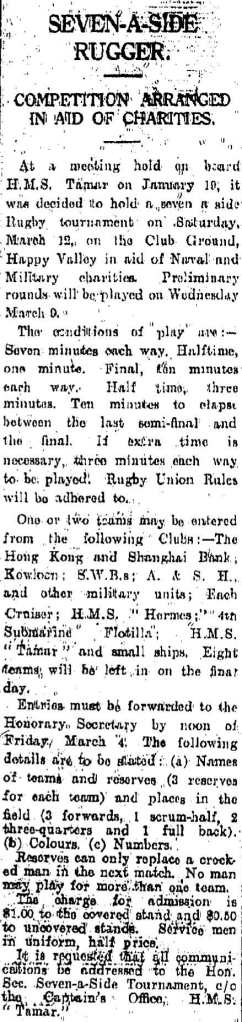
An article appeared in the Hong Kong Daily Express of 29 February 1932, regarding a sevens tournament organised by H.M. S. Tamar.

Preliminary rounds were played on 9 March with the latter rounds and final being held on 12 March.

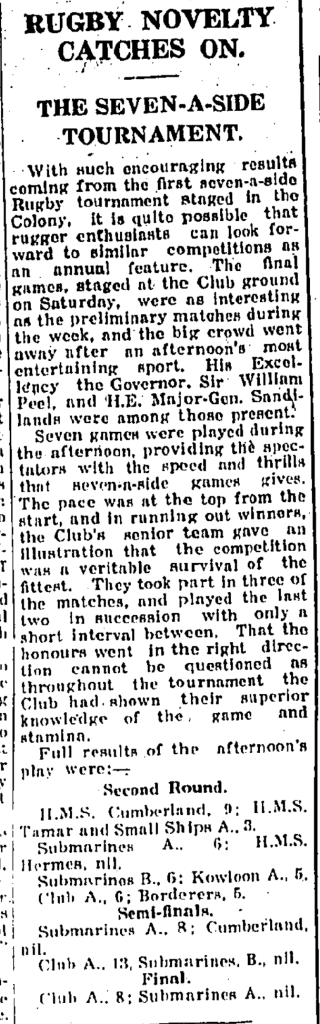
H.M.S. Medway were runners-up in a seven-a-side Rugby Football Tournament, in which several Naval teams competed. The results were:— First round.—Hermes 11, Club B 0; Medway A 6, Kowloon B 0; Kowloon A 21, Tamar B 0: Medway B 6, Bank 3; Club A 26, Tamar C 0. Second round.—Cumberland 9, Tamar A 3; Medway A 8, Hermes 0; Medway B 8, Kowloon A 5; Club A 6, South Wales 13orderers 5. _ _ Somi-finals.—Medway A 8; Cumberland 0; Club A 13; Medway B 0. Final.—Club A 8, Medway A 0 . The Naval teams comprised.—Cumberland A: Mid. Thurstan, L. S. A. Squire, I,ieut. Fisher, R.M., Lieut. Gallimore, Paymaster-Lieut. Kennett (capt), Surgeon- Lieut. Brosnan. Hermes A: Lieut. Wilkinson, A.B. Rumpleman, Sub.-Lieut. Martin, Flight- Lieut. Colquhoun, Lieut. Huhback (capt.), E.R.A. Doggett, Lieut. Padfield. Tamar and small ships A: Tel. Martin, Surgmn-Lieut. Kempthorne, Mile. Wells, E.A.R. Lestherbr, Lieut. Watson. Sub.- Lieut. Paine, Cpl. Ainsworth. R.M. Medway A: I.ient. Woods, Sto. Packer, A.B. Northwood. Lieut. Ryder, Lieut.- Commander Crick (capt), Lieut. Linton, Lieut. Pizev. Medway B: Ord. Art. Fab_rey, Ja E.R.A. Kerr, Lieut. Price Ldg. Cook mes, Plumber Spring (capt.), Sig. Knight, E.R.A. Lomas.

https://www.britishnewspaperarchive.co.uk/viewer/bl/0001973/19320408/242/0013

Blarney Stone Sevens

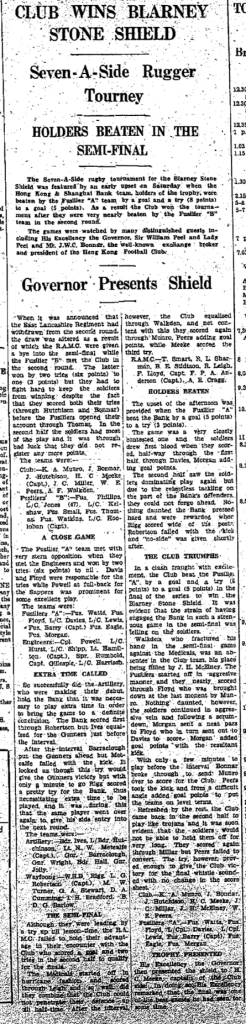
The Blarney Stone was a building in Hong Kong. It seems it was used as a mess for single employees in Hong Kong; and those Blarney Stone residents started a Sevens tournament. The teams played for the Blarney Stone Shield.

A report from the Hong Kong Daily Press of 11 March 1935 states that the holders, the Hong Kong and Shanghai Bank team, were knocked out.

The tournament looks to run between 1934 and 1941, stopping for the Second World War, and then from 1947 to 1986.

Bill Riach Sevens

The Bill Riach Sevens tournament was named after a serving Hong Kong policeman who died in 1963. The Hong Kong police website states:

Not many officers still in the Force would remember Bill, who served from 1957 until his untimely death in 1963. By all accounts he was a well-liked and respected officer who was Canadian by birth but always claimed Scottish ancestry. His lifestyle mirrored his rugby exploits in that he was an aggressive, slightly unorthodox scrum half who played a committed but fair game. At the time of his death he was travelling back to Sha Tau Kok Station, where he was the SDI, when he failed to negotiate a bend and ran off the road into a tree.

As a measure of the popularity of the man, the Bill Riach Sevens was instituted later that year and have been played on an annual basis ever since.

Hong Kong Sevens

An international Sevens tournament is somewhat out-of-scope for this site. However the Hong Kong Sevens has developed into one of the largest Sevens tournaments in the world. It began in 1976.

From ‘The Official History of the Melrose Sevens’ by Walter Allan:

Following the success of the Scotland Centenary Sevens held in Murrayfield in 1973, a group of Hong Kong expatriates created a truly international annual sevens competition and with the sponsorship of Cathay Pacific and Hong Kong Bank, it rapidly became the tournament where the best players in the world take part.

2021-22 Season Sevens Calendar

31 July & 1 August 2021 – Edinburgh City Sevens
7 August 2021 – Peebles Sevens
7 August 2021 – North Berwick Sevens
7 & 8 August 2021 – Dundee City Sevens
14 August 2021 – Hawick Sevens
20 August 2021 – John Laing Sevens
21 August 2021 – Maroon Gala Sevens
9 April 2022 – Melrose Sevens
9 April 2022 – St. Andrews University Sevens
9 April 2022 – Portobello Sevens
16 April 2022 – Edinburgh Northern Sevens
16 April 2022 – North Berwick Sevens
17 April 2022 – Berwick Sevens
23 April 2022 – Broughton Sevens
23 April 2022 – Langholm Sevens
23 April 2022 – Inter-Club Sevens (Musselburgh)
23 April 2022 – Scottish University Sevens
30 April 2022 – Crieff Sevens
30 April 2022 – Howe of Fife Sevens
30 April 2022 – Kelso Sevens
30 April 2022 – Leith Sevens
30 April 2022 – Orkney Sevens
30 April 2022 – Penicuik Sevens
1 May 2022 – Earlston Sevens
7 May 2022 – Musselburgh Sevens
7 May 2022 – Perthshire Sevens (cancelled)
7 May 2022 – Selkirk Sevens
7 May 2022 – Walkerburn Sevens
14 May 2022 – Aberdeen University Sevens
14 May 2022 – Hamilton Sevens
14 May 2022 – Jedforest Sevens
14 May 2022 – West of Scotland Sevens
16 May 2022 – Haddington Sevens (cancelled)
21 May 2022 – Mull Sevens
21 May 2022 – Rugby People Sevens (@Cartha)
28 May 2022 – Biggar Sevens
28 May 2022 – Glasgow University Sevens
28 May 2022 – Helensburgh Sevens
28 May 2022 – Rugby People Sevens (@Garioch)
3-5 June 2022 – Inverness City Sevens
4 June 2022 – Rugby People Sevens (@Corstorphine)
11 June 2022 – Arran Sevens
8-10 July 2022 – Edinburgh City Sevens
9 July 2022 – Caithness Sevens

Page not complete?
Can you provide any information?

Scotland to Canada: the spread of Sevens

By tournament:

1930 Victoria Sevens [Probably cancelled]
1930 Vancouver Rugby Union Sevens [Date mid April]
1931 Montreal Amateur Athletic Association Sevens [Date unknown, though before 24 September 1931]
1953 Spray Sevens, Vancouver [Date unknown]

The list may be subject to change if more rugby union sevens tournaments are discovered.

Victoria Sevens of 1930

The ‘History of the Melrose Sevens’ author Walter Allan states that Victoria had a Sevens tournament in 1930. I could not find any evidence of this; and contacted Doug Sturrock, the Canadian rugby union history expert, to see if this could be clarified. Doug stated: [his text is coloured orange throughout this post]

The sevens tournament planned for Victoria in 1930 may not have taken place because I had read many rugby articles in the Victoria Colonist in the pre- and post- 1930 period.

Vancouver Rugby Union Sevens of 1930

From Doug Sturrock:

I did find that in Vancouver the Vancouver Rugby Union had its first Sevens tournament in mid-April and held it every year about that time until 1938.

Montreal Sevens of 1931

We are on somewhat firmer ground with the Montreal Sevens of 1931, however we are no firmer on the date.

This evidence is due to W. Hastie Cochrane – a Galashiels man then resident in Canada – and his attempts to get rugby union Sevens into the Olympic Games of 1932. [See the post on Olympic try-outs.]

Cochrane’s Olympic attempts made it back to Scotland and were detailed in the Hawick Express newspaper of 24 September 1931.

The Express writes:

Mr. Cochrane’s idea was to get Sevens from Scotland, England, Ireland and France to compete at a tournament at the Games. He says that seven-a-side rugby was recently exploited with success by a athletic association at Montreal and that there is a chance of it being introduced in the States.

Spray Sevens

Doug Sturrock has this on the Spray Sevens:

Robert Spray, who emigrated from England to Vancouver after WWII, started the Spray Sevens in 1953. He was a referee who was the BC Rugby Union president from 1952-1958 and the first president of the revived Canadian Rugby Union (now Rugby Canada) from 1965-1972. The Spray Sevens is still being played.

The Walter Allan statement: ” … and in 1975 the Vancouver Club decided to host a Middlesex tournament.” is incorrect. It was the Spray Sevens. I played in it and we beat Bedford “B” in the first round before losing to UBC. Bedford “A” were the winners thanks to captain Budge Rogers.

Subsequently, other trophies were awarded to Sevens winners in Vancouver: Charlie Foster Shield and Nelles Stacy Shield for a 2nd division or consolation winners.

Doug Sturrock also very kindly supplied this list of Spray Sevens winners:-

1956 Kats
1957 Ex-Britannia
1958 Kats
1959 Vancouver Rowing Club
1960 Vancouver Rowing Club
1961 Meralomas
1962 Meralomas
1963 Vancouver Rowing Club
1964 Kats
1965 UBC
1966 UBC
1967 Georgians
1968 Georgians
1969 Georgians
1970 Georgians
1971 Trojans
1972 UBC
1973 Ex-Britannia
1974 UBC
1975 Bedford (England) OT over UBC Old Boys
1976 Georgians
1977 UBC Old Boys
1978
1979 Meralomas

Montreal Sevens

Montreal had another Sevens tournament in 1956.

Seven-a-side rugby in Quebec started in Montreal in 1956 when Toronto Scottish won it this year and for the next two.
In 1960 the winner was Town of Mount Royal. In 1963 it was at St. Chrysostome in May when Anti-Assassins B defeated Toronto Scottish, in 1966 it was St. Chrysostome in May when UBC Thunderbirds won, in 1968 it was at St. Chrysostome in May when Bective Rangers (Ireland) defeated Meralomas (Vancouver), in 1973 it was on May 19 and in 1978 it was in Montreal on May 20.
Other past winners included : Solihull (England), Toronto Scottish and Combined Services (England).

Other Sevens tournaments

A number of other Sevens tournaments sprang up in the 1950s, 1960s and 1970s.

The Ontario Sevens (1953) and Quebec Sevens (1955 or 1956) were very popular for many years. Halifax (Nova Scotia) had its first Sevens in 1970 and Calgary and Edmonton had their first Sevens in the early 1960s.

There was also the Westmount Sevens in 1959 and the St. Lawrence Sevens at St. Chrysostome on October 10, 1965 won by Montreal Barbarians II.
Sevens for schools started in Montreal (Quebec) and Oshawa (Ontario) in 1964.

After the 1970s, other Sevens tournaments began to be organised:- such as the very popular Bellingham Sevens [Washington, USA]; the Whistler Sevens; the Cowichan Sevens; the SFU Sevens; and the Burnaby Sevens.

As you can see, the majority of this post has been aided by the extremely valuable input from Doug Sturrock, the authority on the history of Canadian rugby union, who graciously also gave me permission to publish his research on this site in correspondence. I am indebted and very thankful for his help.

Doug Sturrock’s book: “It’s a Try! The History of Rugby in Canada.” is over a 1000 pages long and was published in 2017. You can order the book at https://www.rugbyhistorycanada.ca/

Scotland to Russia: the spread of Sevens

By tournament:

2005 European Sevens Grand Prix (Moscow)
2013 Moscow Sevens [28 June]

The list may be subject to change if more rugby union sevens tournaments are discovered.

Introduction to rugby union

William Hopper of Penicuik, Midlothian – and his family – is to thank for introducing the sports of both rugby union and football to Russia. Of the two sports, Rugby Union was introduced first.

Hopper was born on 22 June 1816. He emigrated from Scotland to Russia and opened a machine tool factory in Moscow in 1847.

He was part of a huge wave of Scottish industralists operating in Russia around this time, most notable were:- the McGills – cotton growers and textile producers – Robert (1805-87) and David McGill (1790-1863) from Glasgow; Andrew Muir (1817-1899) from Greenock and Archibald Merrilees from Edinburgh (1797-1877) both merchants who founded the famous TsUM [Tsentralny Universalny Magazin] department store (then as Muir & Merrilees) in Moscow; and Richard Smith (1824-1902) from Greenock, foundry owner and boilermaker.

It was said there was 30 such Scottish industralist families in Moscow alone at the time, with many others based in St. Petersburg.

Hopper founded the St. Andrews Church in Moscow around 1882. (St. Andrew is the patron saint of Scotland and Russia.)

He tried to encourage his Russian workers to play sport. This was not only to maintain their health but was seen as an incentive for them to keep sober!

It was either William Hopper or, more likely, one of his sons, William Hopper Jnr. (1858-1944), that had the idea of introducing rugby union to the Russians.

Hopper’s first factory had a green alongside the factory wall where his factory workers played rugby union (at first) then football. When Hopper expanded his business and planned his second plant in southeast Moscow at Orekhovo-Zuevo, he purposely built a pitch alongside the factory.

Hopper Snr. died on 23 April 1885. His wife and eldest sons then ran the business. The new plant opened in 1886 and rugby union was played on the new pitch.

Rugby was initially a great success and both Russian workers and Scottish expatriates joined in. However the growing interest in rugby by the workers was frowned on by the Czarist police. They managed to ban rugby union later that year (1886); they argued that the sport was too violent and its use might thus help spawn revolutionary ideas!

Not to be deterred in getting his workers involved in sport, Hopper Jnr. then introduced football to the Russian factory workers. It is said that all the Hopper brothers played football. Football won favour with the authorities; and so it was football rather than rugby union that spread throughout the country.

Between 1886 and 1923 any rugby matches that were played were sporadic, although at least one match took place in 1908 between locals and a British trading ship at the Odessa port.

A date of 1923 – after the Russian Revolution of 1917 – does fit with the sport’s re-introduction. The threat of revolutionary ideals from rugby union somewhat diminished as the revolution had already taken place. Rugby Union first began in Russia at least from 1886, dating from when the Hoppers introduced it.

1923 saw the first officially sanctioned match. The Moscow River Yacht Club and the Society for the Physical Education of Workers played out a rugby union match, organised by Mikhail Kozlov (who would later become the USSR’s first national football team coach).

Rugby Union suffered another Russian ban from 1946 to 1956; but in 1957 the second ban was lifted.

Sevens

It is not known if any Sevens rugby was played in Russia in 1886, but it seems likely it was not. The Moscow police may have been less likely to ban rugby union if the fast flowing Sevens alternative was played instead of the XV game.

The European Sevens Grand Prix Series was hosted by Moscow from 2005 to 2007.

The Moscow Sevens international tournament of 28 June to 30 June 2013 billed itself as taking place on the 90th anniversary year of rugby union in Russia. As we have seen, this is not the case.

Scotland to USA: the spread of Sevens

By tournament:

1957 Princeton Tigers v Harvard [16 November]
1960 New York [26 November]
1961 Stanford [December]
1961 San Francisco [December]
1964 Boston [15 May]

The list may be subject to change if more rugby union sevens tournaments are discovered.

Princeton

The Daily Princetonian of Tuesday 19 November 1957 remarks at the end of a rugby article on the 1st team of the Princeton Tigers playing a match against the New York Rugby Club at Fitzpatrick Field on Saturday 16 November 1957… that Princeton Tigers 2nd team played a Seven a side rugby union match against Harvard; and that the Tigers won.

New York

The Fairfield Stag newpaper has various entries of the Fairfield Rugby Club competing in the annual New York Sevens tournament at Van Cortlandt Park. The events are noted as the last Saturday in November.

One note of the fifth annual Sevens tournament of 28 November 1964 notes that 45 teams were invited to that year’s Sevens; the Old Blues club won the 1964 event beating New York rugby club in the final.

Not yet definitely sourced, however the implication is that the first annual New York Sevens was on 26 November 1960.

Stanford

The Stanford Daily of 3 December 1964 noted that the Stanford University rugby club will play in the fourth annual Sevens tournament on the Stanford fields on the 5 December 1964. It notes that 30 teams will compete in the 1964 tournament. As this was the fourth annual tournament it implies that the first annual Stanford Sevens was in 1961, again probably December.

San Francisco

The San Mateo Times of 25 October 1961 notes that the Peninsula Ramblers Rugby Club will take part in the San Francisco Sevens tournament in December of that year.

Boston

The Fairfield Stag newspaper of May 13 1964 notes that on Friday 15 May 1964 the Fairfield rugby club will go to Boston to compete in a rugby Sevens tournament which was sponsored by the Harvard Business School.

Rugby union sevens teams from M.I.T., Dartmouth, Yale, Harvard, Brown and the Harvard Business School were also lined up for the tournament.

Scotland to Jamaica: the spread of Sevens

By tournament:

1937 Savanna-la-Mar [24 May]
1960 Red Stripe [12 October]

The list may be subject to change if more rugby union sevens tournaments are discovered.

Savanna-la-Mar

The Kingston Gleaner of 29 May 1937 writes of a rugby union Seven-a-side match that took place on Jamaica Empire Day morning. (24 May 1937)

The match took place at Savanna-la-Mar and it was between a Kingston side versus a Country side. The match was over 6 chukkas – a chukka, the time division used in the sport of Polo, lasts around 7 minutes – and Kingston beat the Country side.

This was noted as the first game of the season; and after the Sevens match both sides got together and formed the Jamaica Rugby Football Club.

Scotland to Australia: the spread of Sevens

By tournament:

1891 Rockhampton [4 July]

The list may be subject to change if more rugby union sevens tournaments are discovered.

Rockhampton

The 30 June 1891 advert for rugby by the Central Queensland Rugby Union in the Rockhampton Morning Bulletin promised a rugby union match between The Banks versus The Civil Service. Also on the bill was a Seven a side competition. The advert was placed by the CQRU Acting Honorary Secretary C. A. Mathias. Admission was 1 shilling; those with horse or buggy 2 shilling; and women received free entry to the enclosure. The matches were to be played at the Union Ground at Rockhampton’s Cambridge Street.

https://trove.nla.gov.au/newspaper/article/52347037?searchTerm=rugby%20%22seven%20a%20side%22&searchLimits=sortby=dateAsc

The advert was a Charity event for local hospitals and was also placed in the Daily Northern Argus on the same date.

https://trove.nla.gov.au/newspaper/article/213477749?searchTerm=rugby%20%22seven%20a%20side%22&searchLimits=sortby=dateAsc

The report of the match and the Sevens tournament was in the Daily Northern Argus of 6 July 1891. The report of the Argus is fairly circumspect of the notion of Sevens:- it notes that Sevens have been popular in ‘England’ (sic) under the auspices of the ‘English Rugby Union’ (sic). The journalist evidently not making the obvious distinction instead that Sevens were popular in Scotland under the auspices of the Scottish Rugby Union; and not aware that Sevens tournaments were actively frowned on by the English Rugby Union.

The first Sevens match was the Wanderers versus the Waratahs, which the Wanderers won. The Wanderers then played the Berserkers. Dusk was falling and the journalist writes that no-one could tell what the score was – but in any case the match was stopped as one of the Berserkers fell ill with the Wanderers well in the lead.

https://trove.nla.gov.au/newspaper/article/213346865?searchTerm=rugby%20%22seven%20a%20side%22&searchLimits=sortby=dateAsc